What behaviour support involves for children
Positive behaviour support (PBS) is a person-centred, evidence-informed approach to understanding why a child behaves the way they do. Rather than focusing only on stopping a behaviour, a practitioner works to understand what the behaviour is communicating — whether that's frustration, anxiety, sensory overwhelm, or an unmet need — and then builds strategies to help.
A typical process starts with a functional behaviour assessment, where the practitioner observes your child, talks with family and (with consent) educators, and gathers information about triggers and patterns. From this, they develop a behaviour support plan: a written document with practical, tailored strategies for home, school and the community. The plan focuses on teaching new skills, adjusting the environment, and helping the adults around your child respond consistently.
Signs a child might benefit from support
Every child has hard days, but you might consider behaviour support if your child regularly:
- Has intense or prolonged meltdowns that seem out of step with the situation
- Shows aggression toward themselves or others, or damages property
- Struggles to cope with change, transitions or unstructured time
- Withdraws, refuses to participate, or has trouble at school or care
- Displays behaviours that put their safety or others' safety at risk
These behaviours often sit alongside a diagnosis such as autism, ADHD, an intellectual disability or a developmental delay — but a diagnosis isn't always required to seek help.
Suitable ages
Behaviour support can be helpful across childhood, from the early years through to adolescence. Early intervention (roughly ages 0–7) can be particularly effective, as skills and routines are still forming. That said, plans can be adapted for older children and teens, with strategies that respect their growing independence.
What a first appointment looks like
The first session is usually about getting to know your family. Expect the practitioner to ask about your child's history, strengths, interests, communication style, daily routines and the specific behaviours you're concerned about. You may be asked to complete questionnaires or keep a short behaviour diary before or after the session.
It's completely normal to feel nervous. A good practitioner will be non-judgemental and collaborative — you are the expert on your child, and they bring the clinical framework. Bring any reports (from a GP, paediatrician, psychologist or school) that might help.
Typical AU costs and NDIS funding
Behaviour support in Australia is generally delivered by behaviour support practitioners, psychologists, occupational therapists or social workers with relevant training. As a general guide only, sessions and plan development commonly range from around $190 to $230+ per hour. The NDIS publishes price caps that registered providers must work within, and these are updated periodically — always confirm current rates directly with the provider.
Under the NDIS, behaviour support is funded through the Capacity Building budget, typically under "Improved Relationships" (which covers specialist behaviour support) or "Improved Daily Living." Funding can cover assessment, plan development, training for family and carers, and review. If your child is self-managed or plan-managed, you may have more flexibility in choosing providers; agency-managed plans require an NDIS-registered provider.
Costs vary and this is not a quote — ask each provider for a written estimate before you start.
How to choose a provider in Hobart
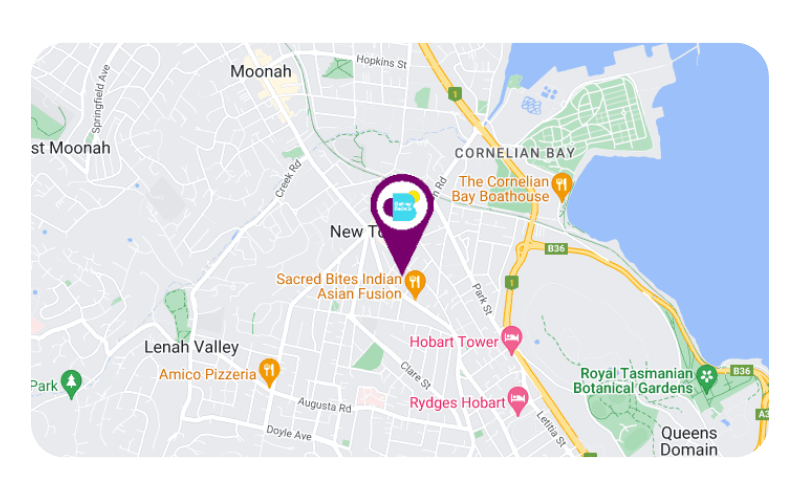
Hobart and surrounds offer options from Howrah and Rosny Park across to Glenorchy, Moonah, Claremont, Kingston and Battery Point. When comparing providers, consider:
- NDIS registration: If your plan is agency-managed, confirm the provider is NDIS-registered. Behaviour support practitioners should also be assessed as suitable under the NDIS Quality and Safeguards Commission.
- Credentials: Check that the individual practitioner is appropriately qualified — for example, registered with AHPRA (for psychologists), or a member of relevant professional bodies such as Occupational Therapy Australia or Speech Pathology Australia where those disciplines are involved.
- Waitlists: Demand for behaviour support in Tasmania can be high. Ask directly how long the wait is for a first appointment and for ongoing sessions.
- Telehealth: If travel is difficult, ask whether some sessions (such as parent coaching or plan reviews) can be delivered via telehealth.
- Fit: Reviews and ratings can help, but the right personality and communication style matters just as much. A short introductory call can tell you a lot.
Questions to ask
- Are you NDIS-registered, and can you work with my child's plan management type?
- What are your practitioner's qualifications and registrations?
- What's your current waitlist for an initial appointment?
- What does your assessment and plan development process look like?
- How do you involve parents, carers and my child's school?
- What are your fees, and do you provide a written service agreement?
- Do you offer telehealth or in-home sessions?
Taking the time to ask these questions upfront helps you find a provider who's the right match for your family — and gives your child the best chance to thrive.