What support coordination involves for children
Support coordination is help to understand and put your child's NDIS plan into action. A support coordinator works alongside your family to connect you with therapists and services, explain how your funding categories work, and make sure your child's plan is being used effectively. For families new to the NDIS, this can take a lot of pressure off — especially when you're juggling appointments, waitlists and paperwork.
There are generally three levels of support coordination under the NDIS:
- Support Connection — short-term help to build your confidence to connect with providers and community supports.
- Support Coordination — help to design and put in place a mix of supports, build your capacity to manage your child's plan, and coordinate between providers.
- Specialist Support Coordination — for more complex situations where a higher level of expertise is needed, often where there are risks or multiple services involved.
A good coordinator doesn't just book services — they help build your skills so you feel more capable of managing things over time.
Signs a child (and family) might benefit
Support coordination is often useful when:
- Your child has just received their first NDIS plan and you're not sure where to start.
- You're spending hours chasing providers, quotes and waitlists.
- Your child has several therapy needs (for example speech, occupational therapy and behaviour support) that need to work together.
- You've had trouble finding services with availability in your area.
- A plan review is coming up and you want help preparing.
- Your family situation is complex and you'd like an experienced person helping to coordinate.
If you feel confident managing your child's plan yourself, you may not need this support — and that's fine too.
Suitable ages
Support coordination is available to NDIS participants of any age, including young children in the early childhood approach (generally under 9) and older children and teens. For very young children, families often work with an early childhood partner first, and support coordination may be included in a plan where the situation is more involved.
What a first appointment looks like
Your first meeting is usually a chance for the coordinator to get to know your child and family, and to go through your NDIS plan in detail. Expect them to:
- Ask about your child's needs, goals and daily routines.
- Explain your plan's funding categories and what each can be used for.
- Talk through your priorities — for example, reducing a therapy waitlist or setting up a new service.
- Agree on how you'll work together and how often you'll be in contact.
Many coordinators offer this first session in person, by phone or via telehealth, which can be handy for families in outer Hobart or regional areas like the Huon Valley.
Typical AU costs and NDIS funding
Support coordination is funded under the Capacity Building — Support Coordination budget in your child's NDIS plan. If it's funded there, it doesn't come out of your therapy budgets.
The NDIS sets price caps for support coordination, and rates differ by level (Support Connection, Support Coordination and Specialist Support Coordination attract different hourly caps). As a general guide, support coordination in Australia is billed by the hour, with Specialist Support Coordination charged at a higher rate. Because caps change with each NDIS Pricing Arrangements update, always confirm current rates and never assume — ask the provider to explain how they bill and roughly how many hours your funding covers.
If support coordination isn't in your child's current plan, you can request it be considered at a review.
How to choose a provider in Hobart
When comparing coordinators, look at:
- NDIS registration — check whether the provider is NDIS registered, particularly if your child's plan is NDIA-managed (registration is required in that case). Self-managed and plan-managed families have more flexibility.
- Relevant credentials and experience — support coordinators come from varied backgrounds. Some sit within allied health organisations. If your coordinator is also a therapist, check credentials with the relevant body (Speech Pathology Australia, AHPRA or Occupational Therapy Australia). Ask about their experience with children and with your child's specific needs.
- Waitlists and availability — ask how soon they can start and how quickly they respond to messages. This matters a lot when you're trying to get therapy moving.
- Telehealth — ask whether they offer phone or video contact, which can suit busy families or those further from central Hobart.
- Independence — some families prefer a coordinator who is independent from the therapy providers they'll be referred to, to avoid conflicts of interest.
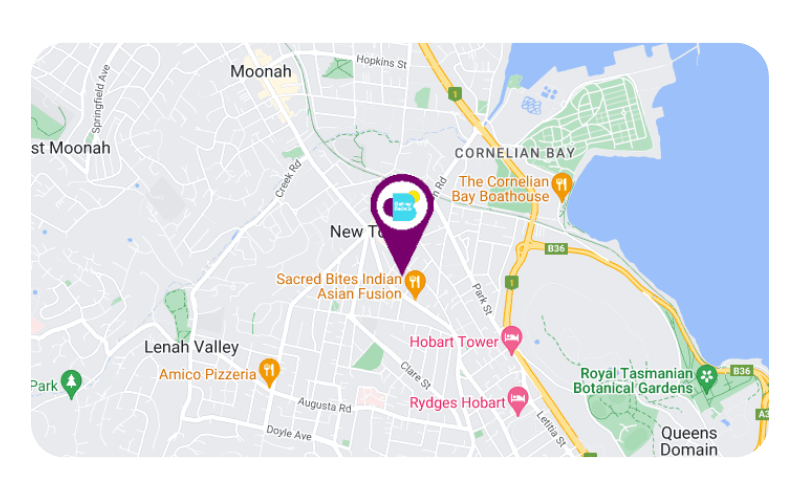
This page features several Hobart-area providers — Beanies Family Support in Huonville, Optimum Health Solutions in Mornington and Moonah, Better Rehab in Rosny Park, and StGiles in Lenah Valley — so you can compare locations and reviews.
Questions to ask before you commit
- Are you NDIS registered, and does that suit how my child's plan is managed?
- What experience do you have supporting children with needs like my child's?
- How many hours of coordination does my plan currently cover?
- How will you keep me updated, and how quickly do you respond?
- Can you help me prepare for my child's plan review?
- Do you offer telehealth as well as in-person meetings?
- Are you independent from the therapy providers you'll recommend?
Taking a little time to ask these questions upfront helps you find a coordinator who's the right fit for your family.